
Don't Just Show Up: How Interactive Trade Show Booth Games Turn Your Stand Into a Lead Machine
So, you've just approved the budget for your next trade show. The booth design is sharp. The branded banners look great. Your team has matching lanyards. And somewhere in the back of your mind, you're already picturing the leads rolling in.
Here's a question nobody wants to answer honestly: what happens when people walk past anyway?
Because they will. Statistically, most of them do. In a hall with hundreds of booths, all shouting about their solutions with slick graphics and smiling staff, you're not competing for attention — you're fighting for a single second of someone's peripheral vision. A beautiful banner doesn't win that fight.
The brands that do win it aren't the ones with the biggest stands or the most expensive carpeting. They're the ones that gave people a reason to stop, stay, and come back — by turning their booth from a display into an experience. And the mechanism they used? Interactive trade show booth games.
The Real Problem With "Just Showing Up"
Let's be honest about what most trade show booths actually are. They're expensive. They're well-intentioned. And for a significant portion of the event, they're ignored.
People walk past. Competitors blend in. Leads evaporate into the crowd before a single conversation happens. It's not a reflection of your product or your team — it's just the brutal physics of a crowded exhibition floor. Attendees are overstimulated, under-caffeinated, and making split-second decisions about where to spend their time.
The conventional playbook — good design, a friendly team, a product demo on a loop — still matters. But it's table stakes now. Literally. Everyone else has a table and a banner too.
What changes the equation is interactivity. Specifically, the kind of fun games for trade show booths that tap into something visitors can't easily ignore: the desire to play, compete, and win.
The Simple Flow Behind High-Performing Trade Show Booth Games
Here's what a well-designed activation looks like in practice.
You add a QR code to your stand. A visitor scans it. In seconds, they're inside a branded game — simple, fast, genuinely fun. They play for two to three minutes. At the end, they enter their email to claim their prize or save their score to a leaderboard. You've just captured a warm lead, extended their dwell time, and created a positive memory anchored to your brand — all without a single cold pitch.
Then something interesting happens. The leaderboard goes up on a screen at your booth. People glance over. They see their colleague's name on it. They want to beat that score. They come back. They bring others. The game hasn't just engaged one person — it's engineered a loop.
That's what separates promotional games for trade shows from every other activation tactic on the floor. It's not a gimmick. It's a system.
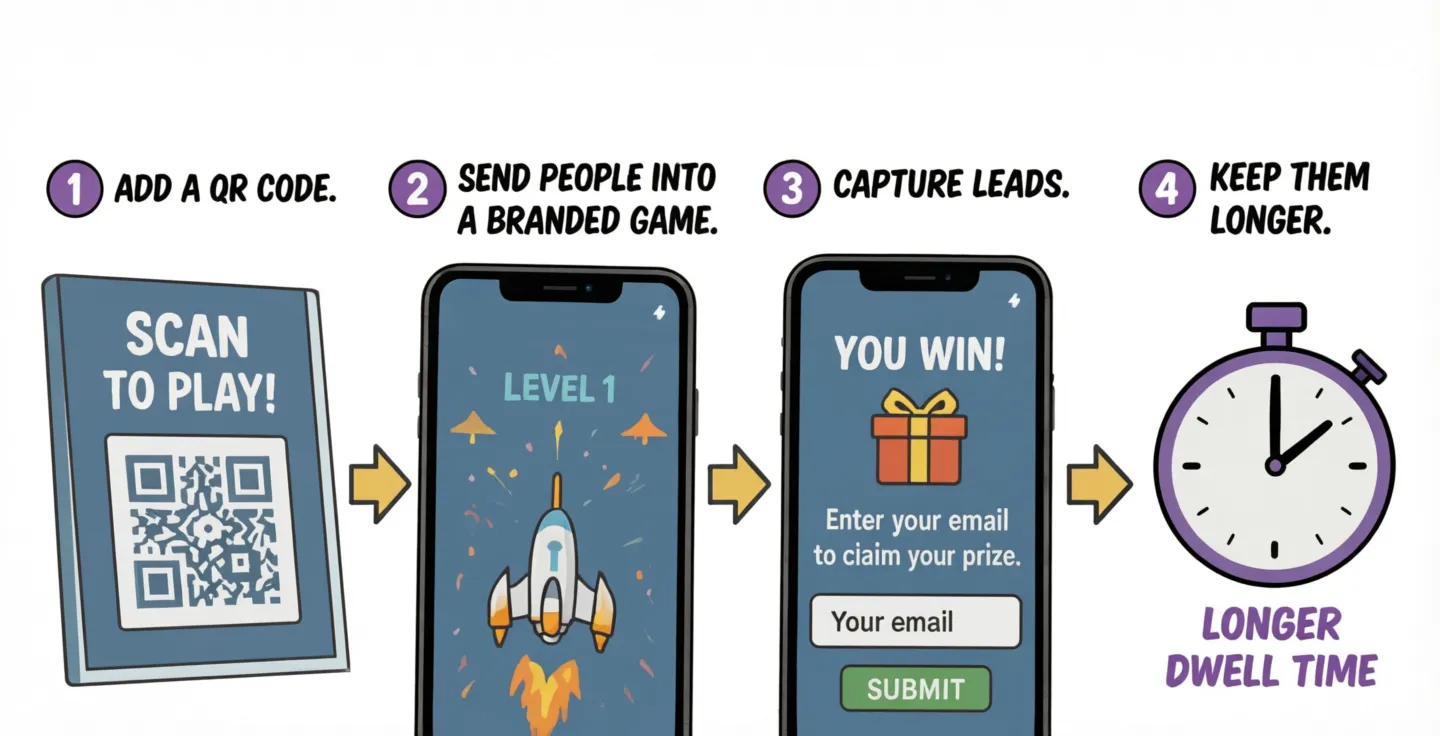 QR-code game flow for your booth
The Numbers Behind Interactive Booth Games
| What You Get | What It Actually Means |
|---|---|
| More Booth Traffic | Interactive booth games create visual energy and crowd FOMO — a busy stand draws more visitors than an empty one, full stop. |
| More Lead Capture | Players submit contact details naturally, post-play, without friction — no clipboard cold-stops required. |
| Higher Dwell Time | A 2–3 minute game keeps prospects at your stand far longer than a brochure ever will. Longer dwell = more conversations. |
| Greater Memorability | Experiences create memory traces. Attendees remember the brand they played with long after forgetting the ones they merely glanced at. |
| Measurable ROI | Every scan, play session, score, and lead submission is trackable data — not vague "brand exposure." |
| Gamified Activations | Add a spin-to-win, prize threshold, or leaderboard reward, and you've turned lead capture into something people actively want to participate in. |
The Psychology Behind Why Trade Show Booth Games Work
This isn't magic. It's predictable human behavior, and understanding it is the key to deploying it intentionally.
1. The Stop-and-Play Effect: Trade Show Booth Games to Attract Customers
Games break the passive scroll of a trade show floor. When someone sees other people actively laughing, competing, or reacting to a screen, the primal social cue kicks in: something is happening over there. Interactive trade show booth games give your stand kinetic energy that static displays simply can't replicate. People don't stop for banners. They stop for experiences — and they stay for the chance to win.
2. The Dwell Time Dividend
A two-to-five-minute game might not sound like much, but in trade show terms, it's an eternity. Most booth encounters last under thirty seconds. Event booth games extend that window dramatically — and every additional minute is another minute for your team to build rapport, answer questions, and move a prospect meaningfully along the funnel. Dwell time isn't just a vanity metric. It's the raw material of conversations that convert.
3. The Frictionless Lead Capture Flywheel
Here's a counterintuitive truth about lead capture at events: asking for contact details before someone has experienced any value is the fastest way to get a fake email address. The smarter play — one that the best promotional games for trade shows are designed around — is to let people in first. Let them enjoy the experience. Let them earn something: a prize, a score, a place on the leaderboard. Then ask for their details to claim it. The psychological dynamic is completely different. You're not extracting their data; you're exchanging it for something they already want.
4. The Leaderboard FOMO Loop
A public leaderboard on your booth screen does three things simultaneously. It adds competitive stakes to the game, making people want to beat each other. It creates a visible signal to passers-by that something worth stopping for is happening. And it generates repeat visits — visitors who played on Tuesday morning will return on Tuesday afternoon to check if they've been knocked off the top spot. Whether you're running conference booth games at a niche industry summit or convention booth games at a large-scale expo, a leaderboard turns a single interaction into a multi-touchpoint relationship, all within the span of one event.
5. Fun-First Branding
You didn't feel advertised to. You were just playing. That distinction matters more than almost anything else in marketing, because it changes the emotional register of the entire interaction. When people have fun in your branded world, they don't build a transactional memory of "I saw an ad." They build an affective memory of "I had a great time with that company." That's the same psychological mechanism that made Candystand.com a destination for 11 million monthly users — and it works just as powerfully at a trade show booth. Custom trade show games amplify this effect further, because a game built around your specific brand, product, or campaign creates an experience that no competitor can replicate.
Why This Matters for Your Business Right Now
The shift toward interactive, game-based experiences at trade shows isn't a trend to get ahead of — it's already the competitive standard in many sectors. The brands that have figured this out are capturing leads while their neighbors are hoping someone will stop to pick up a brochure.
But beyond the competitive argument, there's a more compelling business case: booth games for events are the only format that closes the loop between engagement and ROI.
Traditional trade show presence is notoriously hard to measure. How many people saw your banner? Did it change how they feel about your brand? These questions are almost impossible to answer confidently. A custom trade show game answers all of them — and more — with real data. Every QR scan, every play session, every lead submitted, every score recorded is a concrete data point. You don't just come home with a stack of business cards; you come home with behavioral insights.
What a Modern Custom Trade Show Game Activation Looks Like
A well-designed expo booth game brings together several things that most booths handle separately — attention capture, engagement, lead generation, and ROI measurement — into a single, seamless experience.
A QR code draws people in. The branded game keeps them there. A lead capture moment, gated by a prize or leaderboard position, collects their details naturally. A screen at your stand displays the leaderboard, generating crowd energy and repeat visits. Your team follows up with qualified, warm leads who already have a positive association with your brand — not cold contacts who barely remember scanning a badge.
Before the event, you can tease the game on social media and in email invitations to build anticipation. After the event, the engagement data tells you exactly how your activation performed and which interactions translated into pipeline. That's the full loop. No guesswork required.
Don't Just Show Up
Here's the bottom line. Trade shows are expensive. The booth, the travel, the time, the collateral — the investment is real, and it deserves a return that's equally real and measurable.
Interactive trade show booth games aren't a novelty you deploy because they look good on a post-show highlight reel. They're a systematic way to turn foot traffic into conversations, conversations into leads, and leads into pipeline — with the data to prove every step of that journey.
The brands getting the most out of their events aren't the ones with the biggest stands. They're the ones that gave people a reason to stop, play, and remember.
So the question isn't whether your booth needs an interactive experience.
The question is: what's your game?
At NakNick, we build custom trade show games designed specifically for trade shows, events, and brand activations — built to stop people in their tracks and turn them into qualified leads. Let's design the experience that makes your next event your best one yet.